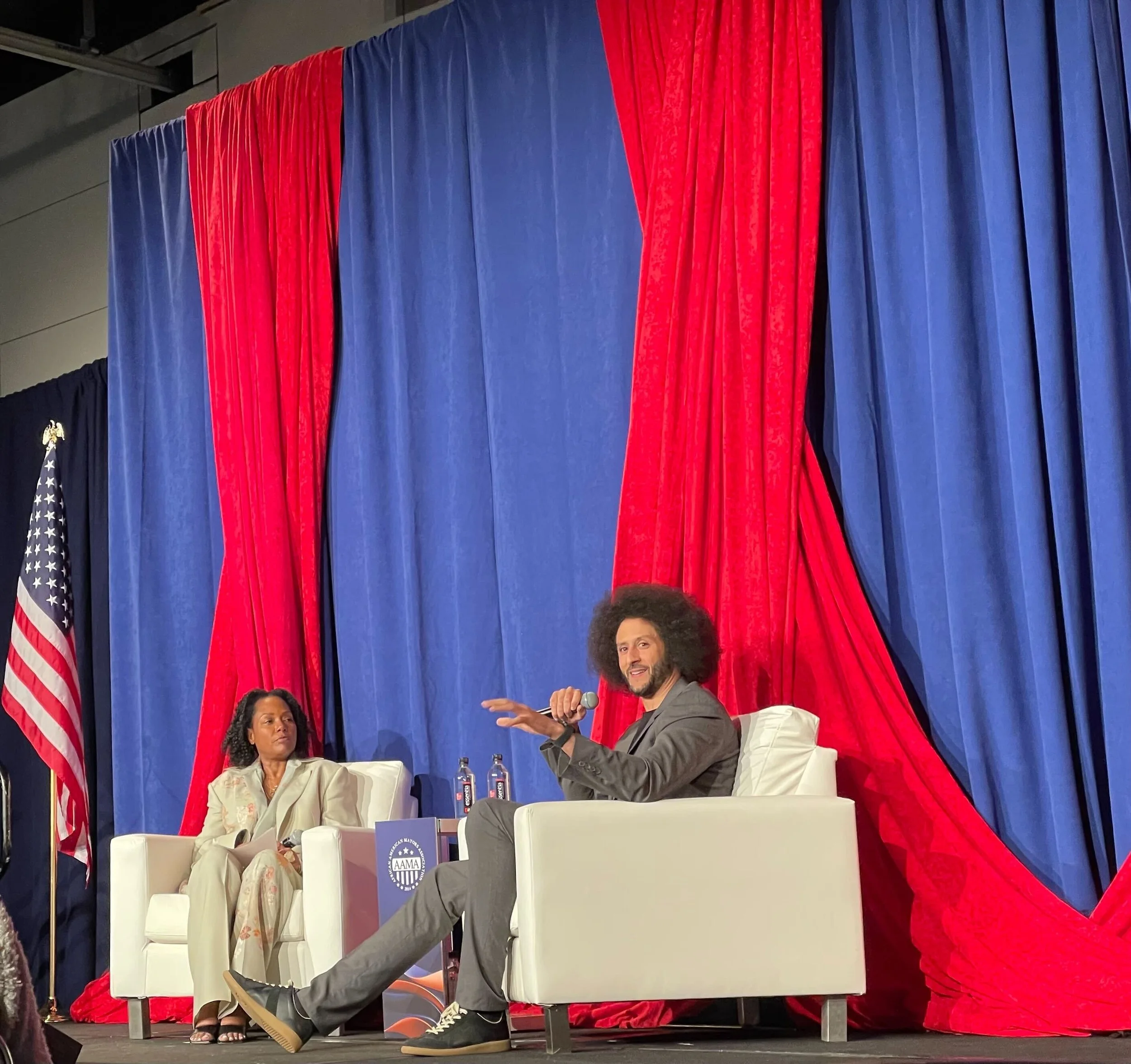
Symbolic Solidarity and Structural Change Are Not the Same Thing
I had never examined Colin Kaepernick's protest beyond my tacit belief that it was righteous. Then I heard him tell his own story, and a different through-line emerged, one with direct implications for every institution that claims to care about racial equity.
Yesterday, I had the privilege of hearing Colin Kaepernick interviewed on stage about his advocacy and the consequences of taking a stand. His story is often reduced to a headline about one athlete, one protest, and one career forever altered. Admittedly, I had never examined his protest beyond my tacit belief that it was righteous, which, in retrospect, is itself part of the problem this essay is about. However, as I listened closely to how he narrates his own journey, a different through‑line emerged: the costs attached to racial justice work are rarely accidental. They are structured, predictable, and often intentionally designed to deter others from taking similar stands. I’ve been acutely aware of these costs for as long as I can remember. I recall telling my academic advisor once that my reluctance to be in front of any movement, rather than behind the scenes, came from the fact that many of my heroes doing social justice work were assassinated.
During the conversation, Kaepernick described being acutely aware of the consequences that might follow his decision to kneel during the national anthem, precisely because history had already offered the blueprint from Jackie Robinson and Muhammad Ali to Tommie Smith, John Carlos, Mahmoud Abdul‑Rauf, Malcolm X, Martin Luther King Jr., and the Black Panthers. Each faced punishment with some paying the ultimate price not only as a response to their actions, but as a warning to others.
For leaders who say they are committed to racial equity, this is not a distant story about sports. It is a diagnostic of how power polices dissent, and a mirror for our own institutions.
Seeing Cost as a Feature, Not a Glitch
Kaepernick spoke plainly about what protest cost him: the work he had trained for since childhood, the income associated with an NFL career, the emotional strain of being turned into a symbol while navigating very personal loss. Those consequences were real, measurable, and unevenly borne.
From a community psychology perspective, naming these dynamics is essential. When systems consistently impose sanctions on people who surface injustice, those sanctions function as a form of structural “risk messaging”: they communicate to others that participation is dangerous and that silence is safer. Over time, that pattern erodes collective efficacy, that is a community’s shared belief in its ability to act together to influence conditions that matter.
Too often, organizations treat these outcomes as unfortunate side effects rather than as evidence of how their cultures are structured. People are praised for “speaking truth to power,” but left to carry the impact alone. In practice, that is not empowerment; it is exposure.
The Cost of Action vs. the Cost of Inaction
Public discourse has long revolved around whether Kaepernick’s decision was “worth it.” His own framing subtly shifts the question. Instead of focusing solely on the personal price of action, he asks us to weigh the collective price of inaction.
If we do not act, what is the cost in lives, health, and safety? What does it mean for a generation of young people to cycle through schools and labor markets without meaningful access to opportunity? How many of the same policy fights are we willing to see replayed because institutions sprint toward symbolic solidarity and stroll toward structural change?
Community psychology has long emphasized that communities are healthiest when people believe their participation matters and when systems respond to that participation with tangible change. When harm and inequity are visible but institutions remain inert, communities experience what some scholars describe as collective hopelessness, the sense that nothing people do will alter outcomes. Kaepernick’s insistence on acting, even without certainty about the end result, is a refusal of that hopelessness.
Collective Action as Risk Redistribution
Perhaps the most pointed lesson for equity‑minded institutions is in how Kaepernick talks about missed opportunities for collective action. He imagines an alternate timeline in which a critical mass of players withheld their labor until the issues affecting Black communities were meaningfully addressed. In that scenario, the financial and reputational risks would have shifted from the individual to the league. The cost of maintaining the status quo would have become too high.
This is also a core insight from community psychology, that risk does not disappear, but it can be redistributed through collective action and shared power. When only a few people speak, they are easily isolated and punished. When communities organize, strategize, and move together, the calculus changes. Power has to respond not just to an individual, but to an organized constituency with leverage, relationships, and alternatives. Said more succinctly, “while revolutionaries as individuals can be murdered, you cannot kill ideas (Thomas Sankara).”
For AsIAm, this resonates deeply with how we think about systems change. Impact at scale requires more than courageous individuals inside institutions. It requires structures that make it rational and psychologically safer for people to act in alignment with equity values.
From Symbol to Infrastructure
Kaepernick has resisted being frozen in time as a single act of protest. Through his advocacy work, he has invested in narrative power, legal consciousness, and literacy for young people, especially Black and Brown youth. The through‑line is clear, transformation requires more than a moment; it requires infrastructure.
In community psychology terms, he is working simultaneously at the level of individual empowerment (building skills, confidence, and critical consciousness), relational power (strengthening networks of support), and structural conditions (shifting access to information, tools, and institutional partners). That multi‑level approach is what allows communities to translate outrage into enduring capacity.
For organizations, the question becomes: are we designing our equity work as a series of symbolic moments, or as a long‑term investment in the conditions that allow communities to exercise power over time?
What This Demands of Institutions
If we take Kaepernick’s reflections seriously, institutions that care about racial justice cannot be neutral about cost. When employees, students, residents, or athletes raise concerns rooted in justice, institutions face a choice: will they amplify the deterrent effect by allowing those individuals to bear the brunt alone, or will they intentionally redistribute risk and build forms of protection around honest participation?
Practically, that looks like:
Designing governance structures where those most impacted by decisions have real voice and vote, not just advisory roles.
Building channels where people can surface inequities without fear of retaliation and responding with transparent repair when harm occurs.
Investing in community‑level capacity (training, data, communications, organizing support) so that demands do not rest on a few heroic shoulders.
Aligning incentives (e.g. budgets, performance measures, public commitments) so that advancing equity is not treated as discretionary labor.
In other words, it means shifting from celebrating individual bravery to cultivating collective efficacy as an organizational norm.
A North Star for Our Work
At AsIAm, we aim not only to help partners “do the right thing,” but to help them re‑design their systems so that doing the right thing is structurally supported rather than individually punished. Kaepernick’s journey underscores why that distinction matters.
The question is no longer whether leaders will encounter costs when they take racial justice seriously. The question is whether we will continue to allow those costs to fall on the same people in the same ways or whether we will build communities and institutions capable of carrying them together.

When Community Feedback Conflicts with Your Plan
It All Begins Here
Many organizations say they value community input. Far fewer know what to do when that input challenges the plan they have already decided to implement.
Throughout my career, I have watched feedback that does not align with an organization’s preferred narrative get ignored, softened, or reshaped until it fits the original strategy. Sometimes the process is even more performative. Meetings are scheduled at times most convenient for the organization, attendees sign an attendance sheet that proves “engagement” to funders, and the process moves on unchanged.
The result is often predictable. We end up with interventions pieced together from partial insights and disconnected from lived realities.
Then we wonder why there is little ownership, why trust is thin, or why the work fails to produce meaningful outcomes. Communities have seen this pattern before, which is why ownership is low, trust is thin, and outcomes rarely shift..
Conflicting feedback is not a barrier to progress. It is a signal that the strategy needs refinement and that the perspectives, incentives, and constraints shaping people’s lives are still missing from the plan.
Pause and Listen Actively
The first step is resisting the instinct to defend the original plan. Engage stakeholders directly, often through one-on-one conversations, to better understand the motivations, experiences, and trade-offs informing their perspectives. This is particularly important for voices that are too often sidelined by decision-making processes.
Active listening shifts lived experience from a data point to a driver of strategy, and from background context to a source of direction.
Map Perspectives and Redefine Success
Conflicting viewpoints often reflect different definitions of success. Some stakeholders prioritize long-term impact, while others are navigating immediate constraints such as time, resources, political realities, or conditions on the ground.
Workshops, focus groups, and facilitated discussions can help surface common themes and areas of overlap. From there, organizations can work with stakeholders to co-create success metrics that reflect multiple perspectives rather than relying solely on the original plan.
This process helps ground strategy in the realities of the communities it is meant to serve.
| Stakeholder View | Common Tension | Reframed Success Metric |
|---|---|---|
| Long-term impact | Short-term needs | Milestones that balance sustainability with early wins |
| Resource limits | Ambitious scope | Phased rollout with clear priorities |
| Political realities | Ideal outcomes | Flexible goals tied to local context |
| Organizational risk | Community risk | Decisions that minimize harm to communities, not just liability to the organization |
Too often, plans are shaped primarily around organizational risk—legal exposure, reputation, funder relationships—while the risks communities face from inaction or poor implementation remain secondary. A more honest definition of success asks whether the chosen path minimizes harm and maximizes safety and stability for communities, not just for the institution.
Document Trade-Offs Transparently
Not every perspective can be incorporated fully into a final plan. Budgets, staffing, timelines, and political realities require choices.
What matters is how those choices are communicated. Naming trade-offs directly and explaining the reasoning behind decisions helps avoid perceptions that community input was tokenized or dismissed.
Transparency builds credibility and helps sustain engagement over time.
Learn and Iterate in Public
Community input should not disappear once planning ends. Organizations should communicate what changed as a result of stakeholder feedback and where adjustments were made.
Equally important is building feedback loops before implementation, during delivery, and after outcomes emerge. These checkpoints allow community insight to continue shaping the work rather than appearing only at the beginning.
When handled this way, engagement moves beyond a procedural requirement. It becomes part of how strategy is developed, implemented, and improved over time. That is the difference between consulting communities and building with them.

When We Already Know the Answer
It All Begins Here
What a Thirty-Year-Old Newspaper Clipping Taught Me About Social Change
It’s 3am and I’m in my head and very much in my feelings.
When I was in graduate school, I coordinated a statewide Point-in-Time Count of homelessness. Before diving fully into the work, I immersed myself in the history of homelessness policy in the city.
I was handed a thick binder documenting decades of advocacy, proposals, pilot programs and other PIT counts. Inside it, I found a newspaper clipping dated the year of my birth. The mayor at the time was advocating for a centralized, coordinated system of homeless services, what many today call a “one-stop shop.” It was not framed as innovative. It was framed as obvious. Necessary. And yet, it took thirty years for that model to become reality.
That moment reshaped how I think about social change. The problems we face are rarely new. How we describe them evolves, but the core challenges and often the solutions remain strikingly consistent.
THE PROBLEM ISN’T IDEAS
What changes is the pace at which we are willing to act. Too often, that pace reflects political caution, institutional inertia, and incentive structures that reward management over resolution. Incrementalism feels safer than transformation. Funding cycles reward activity, not outcomes. Entire systems emerge to sustain precarious existence rather than eliminate the conditions that create it. Nearly everyone benefits from this arrangement except those living under the circumstances.
DELAY AS A DESIGN CHOICE
If a solution is older than a generation, delay is a political and social choice. For institutions serious about equity and impact, urgency must become a design principle, not just a rhetorical one. Implementation timelines deserve the same scrutiny as outcome metrics. Accountability should include not only whether progress occurred, but how long it was allowed to take.
History reminds us that answers are often already known. They sit in old reports, forgotten proposals, and yellowed news clippings, waiting for someone to decide that another generation should not have to rediscover them.